INSIDE GeoLaB - Taking to the skies
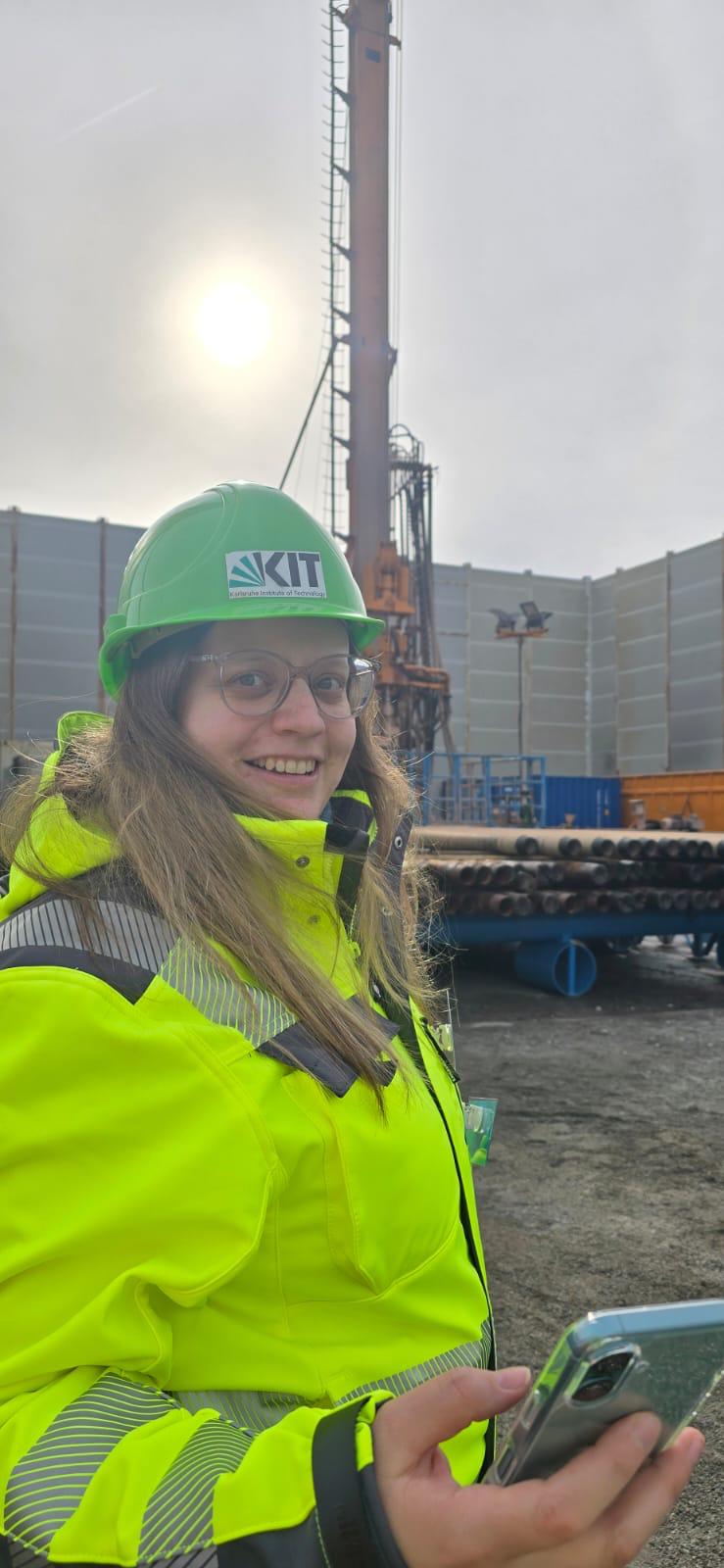
Dr. Nadine Haaf back from the helicopter flight. In the background: The Tromm drilling site.
Dr. Nadine Haaf is a geophysicist at the Karlsruhe Institute of Technology. For her research, she uses various geophysical measurement methods to make processes and structures in the subsurface visible. One of the techniques she employs is measuring the Earth's magnetic field and its changes. For GeoLaB, she took to the skies.
1. Did you take off?
Of course! I flew in a helicopter equipped with special measuring instruments. For GeoLaB, we wanted to get an overview of the subsurface across the entire approximately 20-square-kilometer measurement area in the Tromm region of the Hessian Odenwald. We started in Worms and flew eastward over the Bergstraße towards Tromm. The pilot flew very precise parallel measurement lines about 60 meters apart. To check the data, he also flew a few cross-lines at greater distances. The flight altitude was adjusted to the terrain and kept between 40 and 80 meters — ideally about 50 meters.
2. What is special about this helicopter?
It has a special piece of equipment called the "Noseboom." This is a six-meter-long probe that sticks out like a flagpole from the cockpit. The Noseboom is perfectly designed: It’s long enough to measure the Earth's magnetic field, but only just long enough so it doesn’t interfere with the magnetic field or the helicopter's controls. Inside the helicopter, there are instruments that record the data from the Noseboom. Of course, the helicopter also has GPS to control the flight altitude — and we fly higher over residential areas or pastures out of consideration for people.
3. Why do you measure the Earth's magnetic field?
The magnetic field is locally influenced by the properties of the rocks in the subsurface. Different rocks contain varying amounts of magnetic minerals, which alter the magnetic field. Magnetite is an example of an iron-rich and strongly magnetic mineral. The Tromm granite is a very dense rock. Fractures or fault zones affect its magnetic properties, and this is something we can measure. With the aeromagnetic data, we can detect large-scale differences and structures in the subsurface and visualize them with maps and 3D representations.
4. What did you discover?
The measurements confirm the large geological structures of the region. On the map, the Buntsandstein to the east, right of the Tromm, appears as a relatively uniform blue area. Blue here indicates lower magnetic field values. To the west, left of it, lie areas of granite. There, we measure — as expected — higher magnetic field values, represented in red on the map. The different colors and irregular patterns show that the rock is not uniform. This indicates differences in the rock composition or the content of magnetic minerals. It’s also a sign of geological structures, such as fractures in the subsurface.
5. How does the Earth's magnetic field actually form, and why is it so important?
It forms like this: The outer core of the Earth begins about 2,900 kilometers below the surface. It is primarily made up of liquid, electrically conductive iron. Temperatures there range from about 3,000 to 6,000°C. The inner core starts at 5,150 kilometers, is solid, and reaches temperatures above 6,000°C — about as hot as the surface of the sun! The temperature differences between the inner and outer core create convection currents in the outer core. The Earth's rotation organizes these flows and helps form stable, large-scale vortices. This acts like a geo-dynamo: The electric currents of liquid iron create a massive magnetic field. This field deflects a large portion of the charged particles from the solar wind, protecting the atmosphere — and our life. Without a magnetic field, the Earth would probably not be habitable in the long term.
6. You were part of an aeromagnetic measurement for the first time – what is your conclusion?
I was really surprised by how well aeromagnetics works. It was also fantastic that the national aviation authority quickly gave us the "GO" for our scientific overflight. In addition to the aeromagnetics, ground measurements, including gravimetry and audio-magnetotellurics (AMT), were conducted on the Tromm. These methods provide localized and profile-based information about the density and electrical properties of the subsurface. To get a comprehensive overview of the entire study area, aeromagnetics was the perfect complement. And, of course, it was amazing to be part of the helicopter flight. I filmed some of the sequences from the cockpit with my phone, and some of them are featured in our GeoLaB project film!