Research
Innovative experiments in a geothermal reservoir simulator
Overview and Quick Access

Experimental setup (schematic illustration) with an access tunnel, faults and fractures in the rock mass, monitoring boreholes from the surface and from the underground laboratory, and sensors at the surface and within the laboratory
Research directly in the rock: From fundamentals to application
How can heat from deep underground be used safely and sustainably? This is precisely the question addressed by GeoLaB. In an underground research laboratory, scientists aim to investigate how geothermal energy can be harnessed from hot crystalline rock several kilometers below the Earth’s surface and which processes take place in the subsurface. The goal is to develop new technologies and make geothermal energy from deep crystalline reservoirs a reliable, climate-friendly energy source.
What makes GeoLaB unique is that the planned experiments will take place directly in the rock - where geothermal systems would later operate. Although not at the same depths or temperatures, they will occur in the same type of rock and under the complex conditions of a real environment. This allows hydraulic, mechanical, geochemical, and thermal processes to be observed and studied directly. The insights gained will help to better manage risks such as induced seismicity, plan systems more efficiently, and further develop the use of geothermal energy from crystalline rock.
The development of new technologies benefits from interdisciplinary and international collaboration. GeoLaB therefore brings together expertise from various disciplines and creates a research platform for cooperation between science, industry, and international partners. The results are intended to help make better use of the great potential of geothermal energy from crystalline basement rock for climate-neutral heat supply.
"A key task of research in the GeoLaB will be to improve our understanding of induced seismicity and to experimentally demonstrate measures to minimize it."
Prof. Dr. Thomas Kohl, Karlsruhe Institute of Technology
Classification of the GeoLaB investigation scale
GeoLaB closes the research gap between laboratory investigations and tests in a real geothermal project with deep boreholes. This means that the underground laboratory forms a scientific bridge between investigations on a very small scale and the application reservoir scale. This means that the planned tests in the GeoLaB are an order of magnitude smaller than applications and tests in a geothermal project.
This means also that the response behavior of the subsurface is an order of magnitude smaller. Results from the underground laboratory must be interpreted and transferred to geothermal projects. This is where a major advantage of underground laboratories comes into play: the measurement density is greater than is possible on a real scale in a deep reservoir. This means that processes in the rock can be controlled, observed and described more precisely.
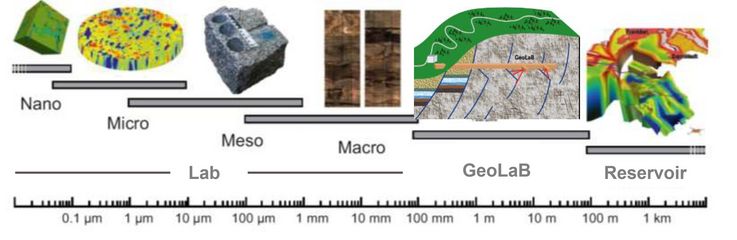
The scales of scientific investigations in geothermal research range from the nano and micro scale — in the order of nanometers and micrometers — up to the scale of geothermal reservoirs deep underground, spanning several kilometers. Scientific tools, measuring instruments, and methods cover this entire range, from microscopes and magnifying glasses to geophysical surveys of large areas.
Scientific Investigations in the Exploration Phase
During the exploration phase, it was investigated whether the Tromm is suitable from a scientific perspective for the planned geothermal research. The key factor is the rock and its properties. Of particular importance is the presence of fractures and cracks in the rock that can transport water. Researchers are therefore conducting studies in geophysics, geology, and hydrogeology.
For this purpose, geophysical and hydrogeological measurements as well as two seismic survey campaigns have been and are being carried out directly on site, and two exploratory boreholes have been drilled. Hydraulic tests and measurements of in-situ stress were conducted in the boreholes. Rock samples obtained from the drilling are being examined in the laboratory with regard to their mineral composition as well as their geophysical and geomechanical properties. These investigations of the rock are complemented by computer simulations.
All these data were integrated to provide a basis for a responsible decision on the scientific suitability of the Tromm for geothermal research, and they confirmed its suitability.
As part of the joint project GeoDT, funded by the Federal Ministry of Research, Technology and Space (BMFTR), the collected datasets are integrated into a digital twin and visualized in 3D.