INSIDE GeoLaB - Worked underground!
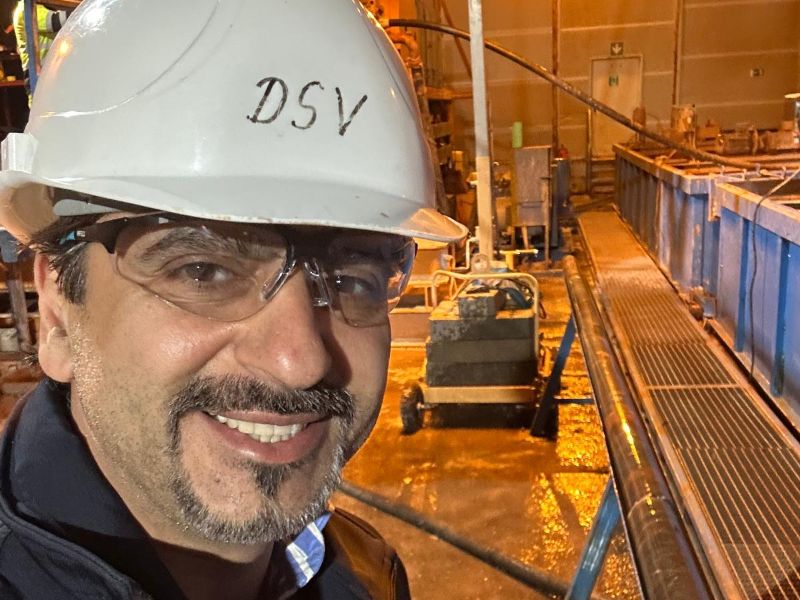
Said Kamrani at the drilling site. "DSV" means "Drilling Supervisor". © Said Kamrani
Said Kamrani is a drilling engineer who has led numerous drilling operations around the world. At GFZ, he works in the departments of Scientific Drilling and Geoenergy. As part of GeoLaB, he planned and supervised two exploratory wells on the Tromm, including a complex deviated well. What´s remarkable is that it was completed ahead of schedule—a win for the budget.
What does your job actually look like?
I always start with the drilling design. We work from the ground up, since as a research institute we don’t have the technical equipment needed for drilling. We therefore have to put that work out to tender and bring in external service providers for the rig, piping, cleaning equipment, and so on. Once everything is up and running, I take on a dual role on site: site supervision and construction management. I’m there continuously in rotating shifts, keeping everything under control, sending daily reports to project management, and making sure the drilling operation runs smoothly around the clock.
How does a drilling operation work in principle?
It’s obviously quite technical, but I’ll try to explain it in a way that’s easy to follow: At the surface, you have the drilling rig. It rotates the drill string (drill pipes and drill collars) and transfers that energy down to the drill bit at the very bottom of the borehole. The drill string is extended step by step: once a section has been drilled, another length of pipe—usually about nine meters long—is screwed on. The cutting elements of the drill bit penetrate the rock through a combination of the weight of the drill string and its rotational motion. In this way, the bit gradually works its way deeper and deeper into the subsurface. The drill bit becomes extremely hot, so it is cooled by drilling fluid that circulates through the borehole. Small particles, such as rock fragments (cuttings), are carried back up to the surface by this fluid. The drilling fluid therefore also serves to keep the borehole clean and to stabilize and condition the borehole walls.
The first exploratory drilling on the Tromm – business as usual?
During the first borehole, we had to bring a core sample up from more than 500 meters depth through the Tromm granite—that’s not exactly routine. Our geologists need rock material that is as intact and high-quality as possible for their analyses. The best way to achieve that is with a straight, vertical borehole and continuous core extraction. Instead of being crushed, the rock is removed from underground as a solid cylinder—known as a core sample—and brought up to the surface piece by piece. Everything went smoothly!
The second borehole was quite a different challenge, wasn’t it?
That was what’s known as a deviated borehole. We deliberately angled it sideways right from the start – over a distance of more than 300 metres. So we drilled at an angle into the subsurface. This allows us to cover a larger area underground than with a straight borehole. Drilling at an angle from the start isn’t standard practice. That also affects the price: no drilling contractor will agree to a flat rate per metre. Unforeseen difficulties could arise, which is why companies charge by the hour. For me, that naturally meant: really stepping on the gas! And it worked out brilliantly. We finished almost two weeks earlier than planned – an absolute rarity.
Did you encounter any critical moments?
Of course – with such complex projects, that’s bound to happen from time to time. At a certain point during the vertical drilling, we noticed that the performance dropped. The drilling was – quite literally – no longer running smoothly. So naturally the question was: where was the fault? I took a closer look at our drilling fluid. The problem was that granite powder had accumulated in the drilling fluid. This made it thick and viscous, like a kind of slurry. And that naturally slows down the drilling progress, because it meant that components of the core barrel kept failing. We replaced the entire fluid, which was quite a job, but after that everything ran smoothly again.
And finally, a fun fact: are diamonds a drilling engineer’s best friend?
Some drill bits have industrial diamonds fitted to their heads. However, these are not comparable to precious gem-quality diamonds. They are manufactured synthetically and look completely unremarkable. But they are frequently used for drilling because they are extremely hard and durable. Nevertheless, diamonds are not always the first choice. Depending on the conditions underground, other high-performance materials are also used, which are, for example, more heat-resistant or chemically stable. Boron nitride is one such material – less well-known, but superior to diamonds and indispensable in several technical applications.